

Making Space While The World Burns
A video podcast conversation with Tareq Baconi on queerness, Palestine, and the courage to tell the truth when silence is expected.

There are moments when making space feels transgressive. When slowing down, speaking honestly, or allowing tenderness to surface can feel out of step with the violence of the world. Sitting with Tareq Baconi for this episode of Out Loud I knew, intellectually, what the conversation would hold: Palestine, queerness, exile, narrative, and power. I did not yet realize how liberating it would be simply to allow all of those truths to exist in the same space, without apology.
In moments of genocide how do we continue to live, to speak about love or memory or becoming, while extermination is live-streamed and normalized? How do we justify softness in a world that rewards cruelty?
That is precisely why this conversation mattered so much to me.
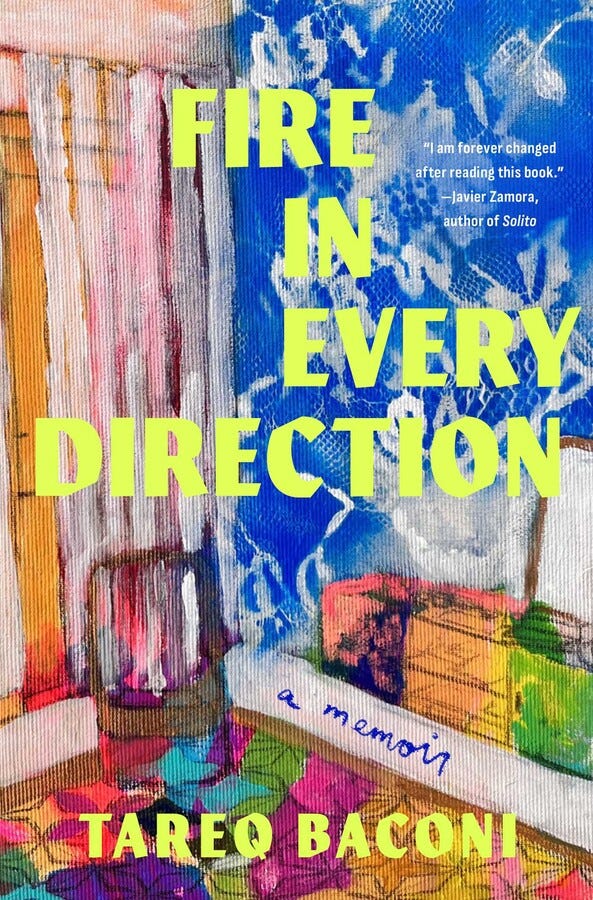
Tareq’s memoir, Fire in Every Direction, is not a departure from Palestine. It is an excavation of it. A story of two boys in Amman, love whispered through letters, and a childhood shaped by “عيب”—shame as social discipline, shame as silence, shame as inheritance. But it is also a story of mothers and rage, of exile passed down through generations, of learning … slowly … that what we are taught to suppress often becomes the very thing that keeps us alive.
As Tareq spoke about returning to letters he carried across countries and decades, I found myself thinking about the quiet intelligence of memory. How it waits patiently. How it does not demand readiness, only honesty. How sometimes we don’t know what we’ve been carrying until we finally open the box.
What stayed with me most was not only the vulnerability of what Tareq shared, but the discipline with which he refused to split himself. Queerness did not need to be explained away to make room for Palestine. Palestine did not need to be softened to make room for queerness. There was no hierarchy of pain, no strategic compartmentalization. Just integration.
That, in itself, felt liberating.
We live in a world that demands fragments. Choose one identity. One struggle. One acceptable tone. Palestinians are expected to speak only of death, and only in the language of institutions that have already decided not to listen. Queer people are told to narrate themselves without anger, without politics, without history. When those worlds collide, the pressure to simplify becomes suffocating.
This conversation resisted that pressure.
There were moments—while reading Tareq’s book, and again while speaking with him—when I had to pause. Not because the material was overwhelming in a spectacular way, but because it was precise. It was visceral.. Close. It demanded presence.
There is something deeply destabilizing about hearing someone articulate the silences you once mistook for personal failure.
When Tareq spoke about shame I thought about how many of us grew up fluent in that language without ever choosing to learn it. How survival can quietly become self-erasure. How hiding can feel like safety until hiding becomes the only posture we know.
Our conversation was animated by rage and by gratitude. Especially when Tareq spoke about his mother. About realizing, years later, that the anger he grew up around was not cruelty but clarity. That rage, when rooted in injustice, can be a gift passed down. A refusal to normalize the unacceptable.
That idea has stayed with me.
So has his insistence that storytelling is not about pleading for humanity. That we do not narrate ourselves to soften institutions that are ideologically invested in our erasure. We narrate to hold power. To maintain agency. To refuse disappearance.
When we stopped recording, I felt steadied.
Liberation does not always arrive as spectacle. Sometimes it arrives as permission: to speak without rushing, to feel without translating, to exist without footnotes. To sit with another person’s story and recognize parts of your own—not as intrusion, but as mirror.
In a world collapsing under the weight of its own violence,
that kind of space matters.
And perhaps that is the simplest truth I can offer about this conversation: making space for complexity, for tenderness, and for truth is not an escape from struggle.
It is part of it.
Love,
Ahmed
This conversation carried so much acceptance, understanding, strength, courage, love, longing and tenderness that left me in pure awe 🤍 raw humanity in every word.
No one has done more to make the world more unsafe than Palestine.