

The Palestine Effect
When the logic perfected in Gaza shows up in Minneapolis.

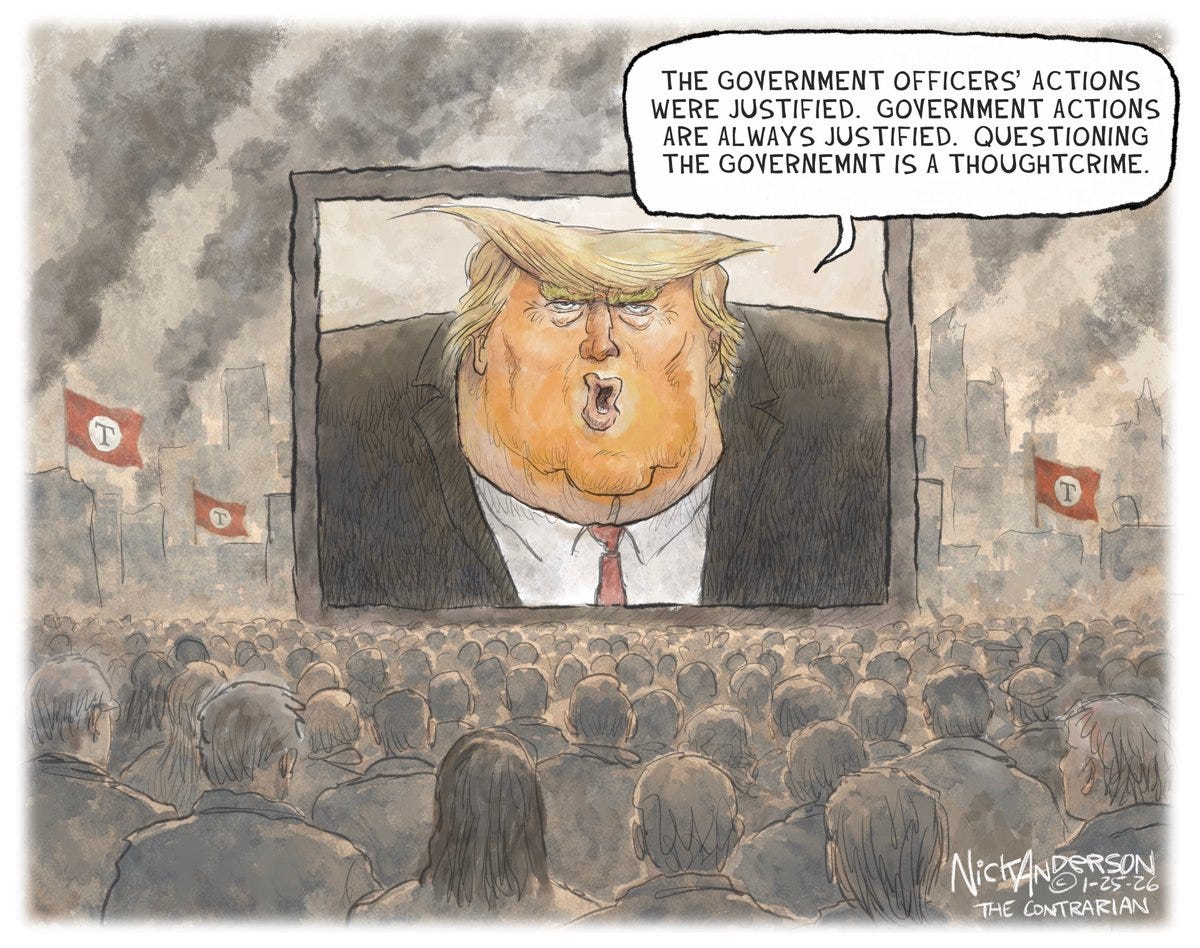
For Palestinians watching—from exile and from under occupation—the outrage in the United States is not a warning. It is the consequence.
What is unfolding now on American streets is the reappearance of a violence long normalized elsewhere, justified abroad, and quietly imported home.
The shock voiced by elected officials, the disbelief of commentators, the insistence that something has gone terribly wrong follow a familiar choreography: denial, then justification, then acceptance. This pattern has accompanied decades of violence against Palestinians. The logic never changes. Only the bodies do.
This is the Palestine effect.
It is how sustained state violence against a designated population becomes administratively acceptable, legally survivable, and politically manageable. It is what states learn when mass civilian harm produces no consequences. When international law is invoked selectively, accountability is endlessly deferred, and violence is transformed rather than stopped.
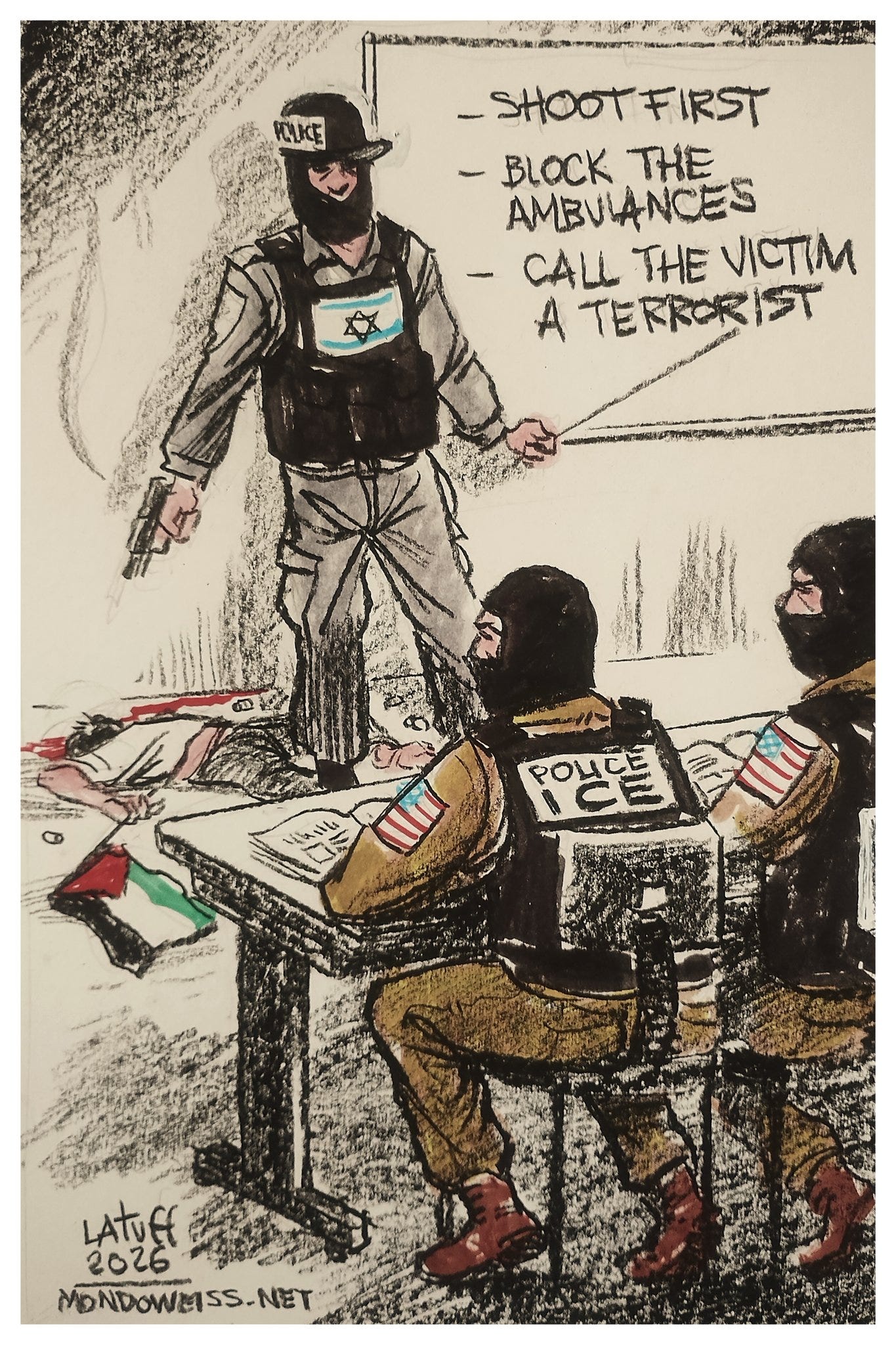
In Minneapolis, U.S. federal immigration agents have shot and killed civilians during enforcement operations. American citizens. Residents. People not in combat zones, and not posing an imminent threat. Local officials have described the deployment as a federal occupation.
Trump’s federal government is invoking “law and order” to justify these actions—even as its agents violate the most basic premise of law and order itself: the prohibition against the state killing unarmed civilians with impunity.
In both Minneapolis and Gaza, civilians are reframed as threats. Public space is treated as hostile terrain. Lethal force is cast as preemptive rather than punitive.
ICE agents shot bystanders including Renée Good and ICU nurse Alex Jeffrey Pretti during raids, blocked medical assistance, and fired on protesters. The killing of Renée Good by federal agents was the predictable outcome of a system that defines certain civilians as disposable and then shields those who kill them from accountability.
This is the first clear link between Minneapolis and Palestine: a state that treats civilian presence as danger, not community.
Once “security” becomes a justification for suspending ordinary legal standards abroad, it becomes available everywhere. “Law and order” ceases to function as a limit on state power and instead becomes a rhetorical shield for its expansion.
That inversion is now visible in Minneapolis. Civilians are killed, and the immediate debate centers not on the conduct of federal agents, but on the behavior, presence, or supposed noncompliance of the dead.
As I was getting ready to hit publish on this post, new video footage from Minneapolis shows a protester screaming for medical attention after suffering a catastrophic hand injury—shot by ICE agents with so-called “less-than-lethal” ammunition during a protest near the site where 37-year-old Alex Pretti was killed.
This is how normalization works.
For years, U.S. law enforcement agencies — including immigration and border authorities — have participated in training exchanges with Israeli police, military, and security forces. Thousands of American law enforcement officials have traveled to Israel to learn repression strategies, crowd control, surveillance techniques, and other methods that advocates say were battle-tested on Palestinians and adapted for use against Black and brown communities back home.
In addition to training exchanges, U.S. Immigration and Customs Enforcement’s investigative arm, Homeland Security Investigations (HSI), has an office in Tel Aviv as part of the U.S. Embassy Branch Office there, where it works with Israeli counterparts on international law enforcement operations.
Security technologies developed in occupation environments are being marketed internationally as “field-tested” and deployed across U.S. policing, border enforcement, and detention systems. Surveillance platforms, monitoring towers, and predictive databases reorganize public space around suspicion.
When public life is saturated with such systems, mere existence becomes provocation. Violence becomes procedural. By the time civilians are killed, the infrastructure has already been built to explain why it was unavoidable.
This is how extraordinary force becomes the status quo.

The deaths of Renée Good and Alex Pretti are visible because they happened in public view. They are not exceptional.
In 2025, at least thirty people died in ICE custody. Many were held without criminal convictions. Many died from medical neglect, delayed treatment, or conditions families describe as entirely preventable.
We know Renée Good’s name because her killing occurred in the open. But ICE spent 2025 disappearing brown bodies behind walls and wire—people extinguished quietly by a system designed to avoid sustained scrutiny.
This did not begin with Donald Trump. ICE was consolidated and expanded under Democratic administrations. It was during the Obama years that mass detention and deportation were normalized as tools of governance and the agency’s militarization accelerated.
Over four years, ICE’s budget has reached roughly $170 billion, placing it among the largest armed enforcement forces in the world.
ICE exists to terrorize immigrant communities through detention, deportation, and death—to make survival conditional for anyone who falls outside the narrowing boundaries of who is deemed worthy of protection.
For years, U.S. leaders treated the brutal subjugation of Palestinians as distant—tragic, “complicated,” safely foreign. That distance was always an illusion.
A government that funds, arms, diplomatically shields, and rhetorically defends mass civilian harm abroad cannot credibly claim immunity from the logics it normalizes.
What was once described as counterterrorism becomes enforcement.
What was once framed as occupation becomes public order.
What was dismissed as distant becomes domestic.
Americans were told democratic safeguards would prevent this. Minneapolis exposes the fragility of that promise.
A government that learns it can enable mass civilian slaughter without consequence does not forget that lesson at its borders. Institutions that spend years laundering violence through euphemism do not abandon that language when the victims change passports.
The Palestine effect is how violence is normalized, legality hollowed out, and humanity made conditional … first for one population, then for another.
What remains is the question Palestinians have been asking for generations:
Who is protected by the law—and who is merely subjected to it?
Palestine was never only a place.
It was a warning.
That warning has now come home.
The prophetic Malcolm X said that chickens always come home to roost.
Gaza was just practice. We tried to tell them and no one listened until now.
I’m Palestinian-American BTW.
Thank you for this Ahmed, we knew it would come back to bite us in the ass, but too many people were brunching and sipping Starbucks, or punching us at protests, or assuming that voting democratic would solve whatever problem they have personally. As Israel must fall, so must the United States.